

BLOOMINGTON — When railroads first reached these parts in the early 1850s, the economic interests of Bloomington and the surrounding countryside turned northward to the emerging commercial and industrial behemoth of Chicago.
Yet before the steam locomotive revolution, Bloomington forged close economic ties with the Illinois River communities of Peoria and Pekin. And once on the waters of the Illinois, one could reach larger cities on the Mississippi, namely St. Louis and New Orleans, as well as those on the Ohio, like Louisville and Cincinnati.
River transportation made available goods not manufactured by — or available to — early Central Illinois pioneers, such as window glass, cedar shingles, white pine shutters, cast-iron stoves, cookware, tableware, fine furniture and items innumerable.
In some ways, river travel was easy compared to that on land. To breach the 35-mile or so divide between Peoria-Pekin and Bloomington, goods were hauled by freight lines operating heavy wagons, with nary a bridge in sight. This was often a maddeningly difficult journey defined by mud and marked by the swollen Mackinaw River, several sizable creeks and innumerable sloughs. For travelers of some means, stages ran between the two communities, offering a kidney-bruising ride in dry season and an equally unpleasant experience in weeks marked by rain or snowmelt.
People are also reading…
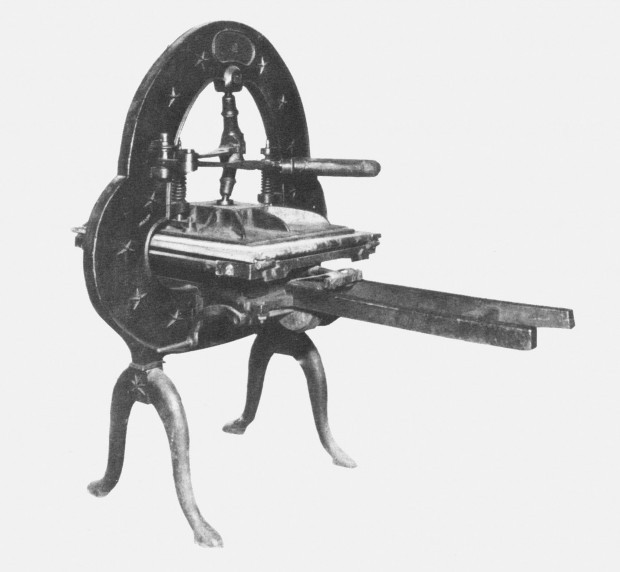
In 1836, Bloomington promoters Jesse Fell and James Allin decided their growing but still-rustic county seat needed a newspaper. These two commissioned the excitable Asahel Gridley, who would later become Bloomington’s first millionaire, to procure a printing outfit back East, which he did in Philadelphia.
The printing press (see accompanying image) arrived in Bloomington having been shipped via the Atlantic Ocean and Gulf of Mexico, and then up the Mississippi and Illinois rivers to Pekin, where freight line operator Benjamin DePew hauled it across the open prairie to its new home.
The trade was a two-way affair, though, with the bounty of the countryside, mostly grain and hogs, sent to commercial centers on the Illinois, Ohio and Mississippi rivers.
In the early 1900s, James Haines, whose brother William played a role in Pekin’s early trade, recounted the pre-railroad days and the economic link between the Illinois River and Bloomington. Pekin quickly established itself as “the first great grain and hog market” upriver of Beardstown, he said, a position maintained throughout much — if not all — of the 1830s and 1840s.
One reason for this was the roads in and out of Pekin were superior to Peoria’s, a fact helping to make the former the larger (at least early on) of the two markets. “My recollection,” Haines wrote of the era, “is that from 30,000 to 36,000 head of hogs were bought and slaughtered in Pekin annually.”
The steamboat is forever linked in popular culture to romance and song, though for the early settlers its primary purpose was that of commerce.
“Very large steamboats from New Orleans and the Ohio River came each spring in high-water time and lay for days together, near the pork and grain houses (of Pekin), taking from them the large accumulated stocks of fall and winter and bearing them to southern markets mostly,” Haines added. “Besides these large steamers running only in high-water seasons, there were many smaller ones (called “wharf boats” or “packets”) constantly plying along the Illinois River from St. Louis, Cairo, Louisville, Cincinnati and other Mississippi and Ohio River points.”
A year before railroads reached Bloomington, the city’s lone newspaper (a weekly called The Intelligencer) carried advertisements for the Garden City, a “new, fast-running steamer” operated by H. Myers & Co. of Pekin. This vessel required five days to make a roundtrip St. Louis run, “touching at all the intermediate ports along the river.” Myers also operated a warehouse and wholesale operation, offering “cheap for cash” staples such as coffee, salt, lime and cement.
The pages of The Intelligencer were filled with Pekin commission merchants and retail stores advertising everything from tobacco to nails to children’s toys. One such operation was G.W. Freeman, “dealer in clocks, watches, jewelry, cutlery, musical instruments & fancy goods.” He also sold books and stationery, including schools texts in English, German, Spanish, French and Latin.
Romantic or not, Bloomington’s steamboat era came to an end in 1853 with the coming of two railroads, the Illinois Central in May and the Chicago & Mississippi (later the Chicago & Alton) in October. The locomotive (a steam engine on rails) was faster, more efficient and more reliable than its river cousin, and able to run year-round, even when rivers were choked with ice.