

Every street, avenue, boulevard, circle, court, lane, parkway, place and road in the Twin Cities has a name, and for each name there’s a story. Street names can tell us much about the community’s past—its pre-settlement landscape, first settlers, town founders, war heroes, mayors, long-forgotten enterprises and, most recently, the proclivities and family members of real estate developers.
Named streets, as a matter of fact, predate the settlement of Bloomington. The city’s first lots were sold at public auction on July 4, 1831, with the “Original Town” (as this platted section is still known) consisting of 12 blocks and 9 streets staked out on the open prairie. Initially, Bloomington was bound by North, East, Front and West streets, while in between were Main, Center and Madison (running north-south) and Washington and Jefferson (running east-west). As far as street names go, it was a rather ho-hum mix: three Cardinal directions; three Founding Fathers/early U.S. presidents; and the ubiquitous Center and Main.
People are also reading…
The exception was Front Street, which should’ve been called South Street, but was so named because it “fronted” the edge of 6,200-acres of virgin timber known as Blooming Grove. North Street was later changed to Monroe for James Monroe, the nation’s fifth president, and West was renamed much later for another White House occupant, Theodore Roosevelt.
Much of what we know about the names of older streets comes from John H. Burnham, who published a lengthy paper on the subject in 1899. From Burnham, for instance, we learn that Bloomington founder James Allin named Lee Street for his son Lee Allin. To the west of Lee is Allin Street, named for James himself, while the street to the immediate west of Allin is Catherine, named for his wife.
Some streets speak to a more bucolic past (Grove and Prairie, for example), while others carry grittier connotations, such as Butchers Lane. Located south of Park Hill Cemetery, the main stretch runs west to the Union Pacific/Amtrak line and to an area where livestock were once loaded and offloaded onto railcars and others presumably “processed” for the dinner table.
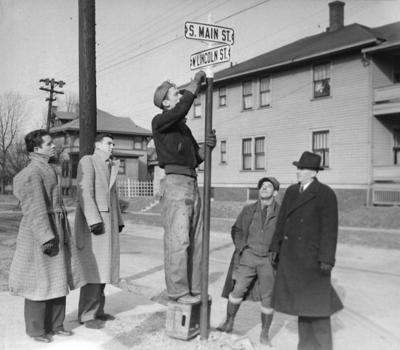
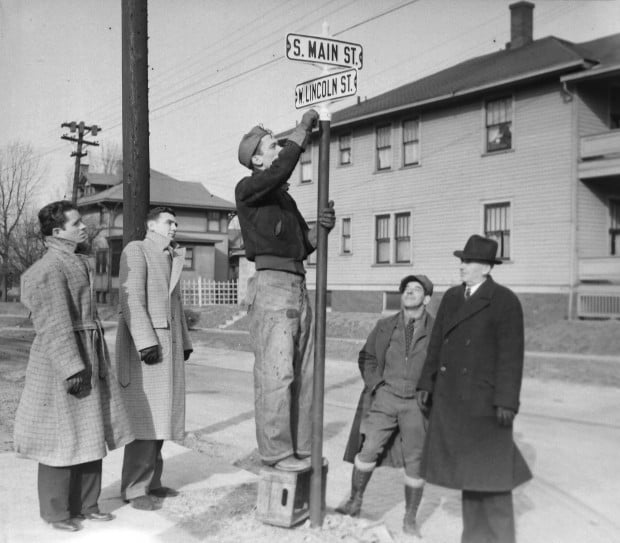
In the south end of Bloomington, the streets of Bissell, Buchanan, Fremont and Lincoln were named around the time of — or not long after — the 1856 national and state elections. James Buchanan and John C. Fremont were the major party presidential candidates (Democrat Buchanan won), while William H. Bissell became the first Republican governor of Illinois. For his part, Abraham Lincoln played a key role that year in the formation of the state GOP. Some have maintained that Bloomington’s Lincoln Street was the first in the nation named for the man who would become the 16th president, though the claim remains unsubstantiated.
Beginning in the 1950s and the boom in postwar subdivisions, real estate developers began enjoying an oversized role both shaping the contours of the growing community and naming hundreds and hundreds of new streets. The Fleetwood subdivision in Bloomington, located south of Jersey Avenue, carries names tied to its developer Paul E. Ball. His father drove a Fleetwood Cadillac (hence the subdivision’s name), and since Ball held a passionate interest in automobiles there’s Continental Court and Imperial Drive.
Kent and Thomas drives, just east of Underwood Park in Normal, are named for sons of developer Dr. Marion L. Taulbee. Walter Benson developed a small subdivision west of Morris Avenue and north of Six Points Road. As a member of the Church of Latter Day Saints, Benson named streets for Mormon church leaders, including McKay Drive for David O. McKay, while Welling Street comes from Maye Welling, a Mormon missionary who changed Benson’s life.
In 2002, Larry Hundman, with the help of Terri Clemens, former real estate agent and current registrar for the McLean County Museum of History, named more than a dozen streets in the Tipton Trails subdivision for local residents with a claim to fame of one sort or another. There’s Fifer Drive for “Private Joe” Fifer, Illinois governor of the late 1800s, and Bohrer Court for Fifer’s daughter, Florence Fifer Bohrer, the first woman to serve in the Illinois Senate. Stevenson Drive is named for both Adlai E. Stevensons: Adlai I, the vice president during Grover Cleveland’s second term; and grandson Adlai II (the unique name skipped a generation), twice Democratic candidate for U.S. president.