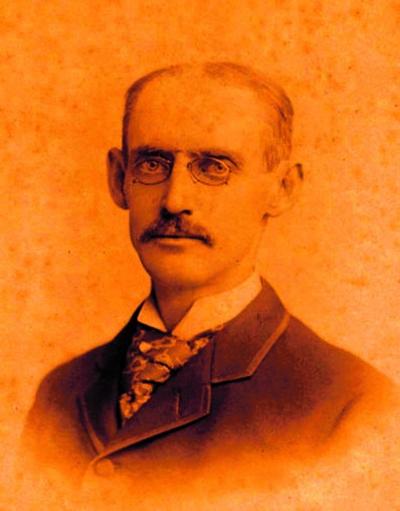


Newspapers were once indispensable to the health of the body politic, and in an age long before television and the Internet, Melville Elijah Stone was one of the most successful and respected newsmen in the U.S. And as the visionary manager of The Associated Press, his influence extended to the far corners of the globe.
Stone was born Aug. 22, 1848, in Hudson, to Elijah and Sophia Creighton Stone. The Rev. Stone was an itinerant Methodist preacher who served something like two years as pastor to the small McLean County community’s Methodist congregation.
Services were held in the homes of parishioners or a local schoolhouse until the erection of a church in 1849.
The parsonage was not built for several years after that, so the Stones lived at the James T. Gildersleeve residence (known as “Five Oaks”) in Hudson, and it was there that Sophia gave birth to Melville.
People are also reading…
Although Stone spoke fondly of his family and upbringing, singing the praises of “the homely western conscience” whereby folks “did not measure a man’s morals either by his manners or his money,” all was not wine and roses.
“A pioneer Methodist minister in Illinois in the [eighteen] forties led a gypsy life,” Stone recalled. “The compensation was beggarly; it was missionary work … When they repeated the Lord’s Prayer, their petition for daily bread was no meaningless appeal.”
Stone’s legacy rests with the establishment of the Chicago Daily News in the mid-1870s, and, more importantly, his 26 years as general manager of the reorganized AP, which under his leadership became one of the greatest newsgathering operations the world has ever seen.
In its heyday, the Daily News was a leading American newspaper with its pioneering international coverage by correspondents in London, Paris and other seats of Victorian and Edwardian realpolitik.
It was also Chicago’s first “penny paper,” and a fanciful story has it that Stone, frustrated by the lack of 1-cent coins in circulation, brought into the Windy City barrels of pennies direct from the U.S. mint.
He also convinced merchants (or so the story goes) to price goods at 99 or 59 cents, the idea being the penny change could be used to buy his Daily News.
But it was as the longtime general manager of the AP that he earned a national and even international reputation.
At a time when many newspapers were closely aligned with political parties and ideologies, Stone forged a modern news service that thrived on reliable and generally unbiased reportage generated from press bureaus scattered across the globe and disseminated by way of a sophisticated telegraph network. In many ways, Stone’s AP staked its reputation on “fair and balanced” news when that phrase was more than a cynical marketing ploy.
Melville Stone passed away on Feb. 15, 1929, in New York City. In its lengthy tribute, The New York Times called Stone “one of the best known and liked newspapermen in the world.”
He was entombed in Washington National Cathedral in the nation’s capital, which also serves as the final resting place for President Woodrow Wilson and other Americans who wielded their share of influence and power.
In 1933, the Optimist club of Normal erected a monument to Stone (in the form of a bronze tablet affixed to a massive boulder) in front of the Gildersleeve homestead.
Stone is one of three favorite sons of Hudson born within 12 years of each other, the two others being Wild West impresario Charles “Buffalo” Jones (1844-1919), and writer, art colony entrepreneur and self-styled philosopher Elbert Hubbard (1856-1915).
Stone recalled meeting Hubbard on two occasions, the last a fateful one. On May 1, 1915, according to Stone’s recollection, he was disembarking from the British passenger liner RMS Lusitania at New York City’s Pier 54 when he bumped into “Fra Elbertus” (as Hubbard was known) and his second wife, Alice Moore Hubbard, going the other way. Stone had just returned from a Europe in the early throes of the cataclysmic “War to End All Wars.”
“We chatted a moment,” Stone remembered. “We spoke of the threatening advertisement in the morning paper, cautioning people against taking passage on the ship [due to the threat of German submarines].” “Well, if they sink her,” Stone remembered Hubbard laughing, “I will meet the Kaiser in hell.”
Six days later, May 7, a U-boat torpedoed the luxury liner, taking the lives of the Hubbards and nearly 1,200 passengers and crewmen.
Also lost aboard the Lusitania were Stone’s son, Herbert, and his wife, Martha Grigsby McCormick.